

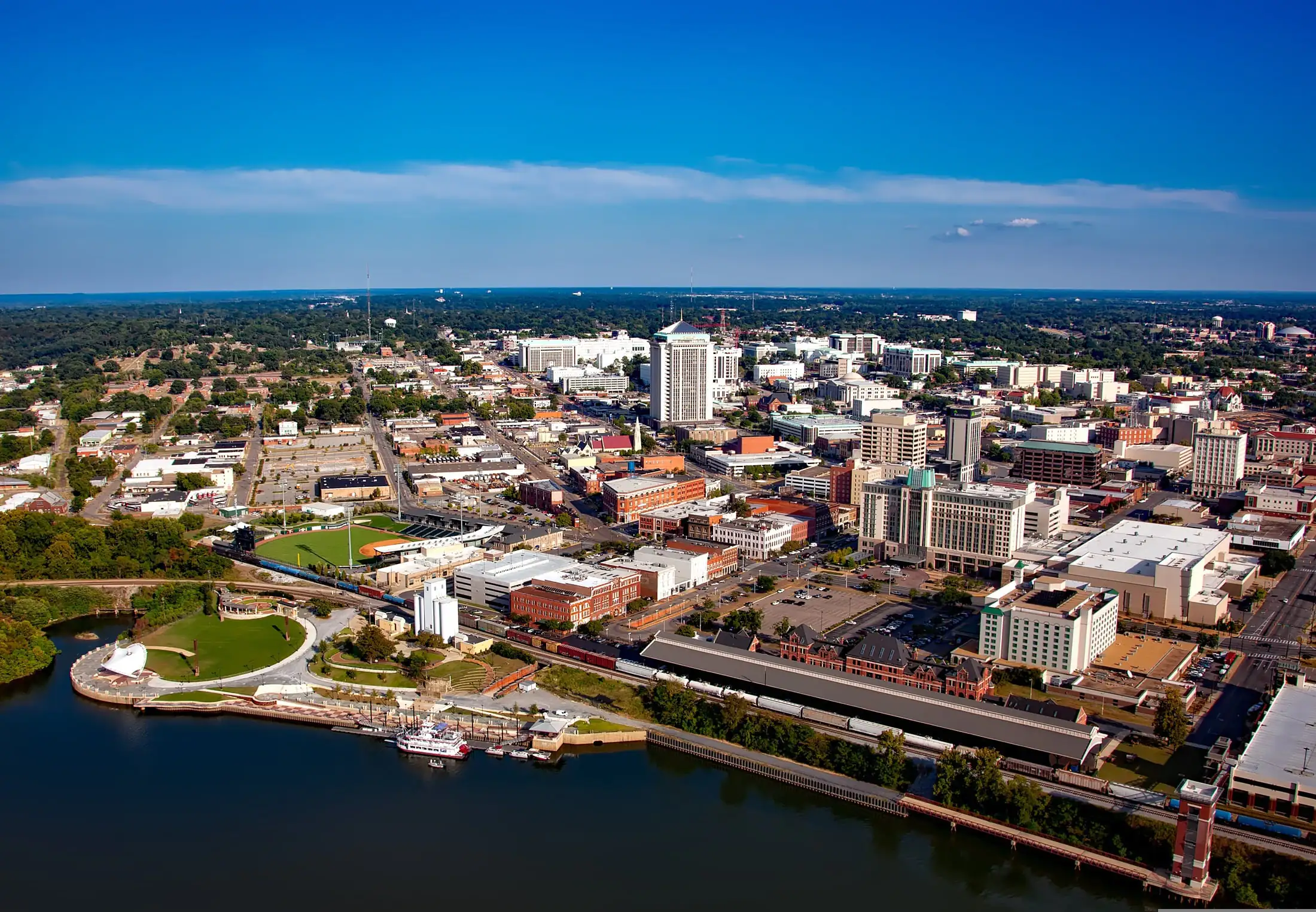
The Montgomery City Council in Alabama has adopted the Greater Floyd Campus Master Plan, detailing the revitalization and transformation of an underutilized area into a comprehensive mixed-use district.
The site currently encompasses properties under both public and private ownership. These include the Floyd elementary and middle schools, the Floyd Community Center, a former Emergency Management Warming/Cooling Center, the Therapeutic Recreation Center, a 4.1-acre open green space and other properties.
Notably, the plan also prioritizes adjacent private properties that have fallen into disuse and damage the character of the area. These include commercial buildings and an abandoned residential property.
A major driver for the initiative would center around converting the Greater Floyd Campus area into a community hub as the city emphasizes connectivity, street safety, recreation, public gathering spaces, local infrastructure and revitalization of dilapidated and underused properties.
Among the plan recommendations, the city would renovate and modernize existing civic infrastructure – particularly the community center and nearby buildings. The city would renovate the Floyd Community Center, bringing it back to modern standards. Additional work would repurpose two adjacent structures into a Community Resource Center and office spaces.
In associated work, the document outlines plans to expand the Montgomery Therapeutic Recreational Center with a therapeutic community garden. The garden would include a dedicated pavilion, a walking path and upgrading the nearby playground to replace aging equipment and encourage play.
To further enhance recreation opportunities, the city would build state-of-the-art turf baseball and soccer fields designed for year-round usage. The fields would be anchored by an open-structure pavilion to provide a central gathering space, shade and restrooms. The project scope would also call for converting basketball courts into pickleball courts.
As the city council continues to emphasize community developments on the site, the plan calls for building a mixed-used structure with residential and retail spaces near the Norman Bridge commercial area. The city may have to demolish the existing building and repurpose its materials for other projects. In addition, the city would build a two-story multi-family development near Richmond Road, revitalizing a blighted area for the neighborhood.
Additional recommendations would include transforming a former school into a historical walking trail, building bicycle lanes and installing removable bollards and a raised table to provide non-motorized linkages throughout the complex. The city would also build a road, implement traffic calming measures, expand and build new parking and install lighting, fencing and security cameras.
The master plan will be executed across four distinct phases determined by priority. Phase 0 will covers preparations for the remaining stages. Phase 1 projects – centering around immediate priorities – will demolish properties, improve connectivity, enhance existing facilities and redevelop recreational spaces. Phase 2 will prioritize mid-term projects, including civic infrastructure improvements and expansion. The final phase covers long-term scenarios, including acquiring and redeveloping non-city-owned properties, completing streetscape work and developing the future roadway.
Photo by Pixabay
For more of the latest from the expansive government marketplace, check Government Market News daily for new stories, insights and profiles from public sector professionals. Check out our national contracting newsletter here.