


The Washington State Department of Transportation (WSDOT) has selected a preferred alternative for reconfiguring the Interstate 90 highway ramps at Rainier Avenue South near Seattle’s Judkins Park light rail station. The plan would remove one freeway ramp and reshape the interchange to improve safety for pedestrians, cyclists and transit riders.
The initiative, dubbed the I-90 Judkins Park Station – Reconnecting Communities Study, has $3 million set aside for planning and up to 30% design work, funded by a $1 million federal Rebuilding American Infrastructure with Sustainability and Equity (RAISE) grant and a $2 million state Sandy Williams Connecting Communities Program (SWCCP) grant.
WSDOT has been studying potential changes to the five I-90 ramps at Rainier Avenue South since 2023, building on a 2017-2019 station access study conducted by the Seattle Department of Transportation (SDOT). The study is timed with the opening of Sound Transit’s Judkins Park light rail station, which is scheduled to begin service on March 28 as part of the agency’s 2 Line extension across Lake Washington.
After months of traffic modeling and analysis alongside a 24-member community advisory group, WSDOT announced in late February that it is recommending Alternative 2 for the interchange. The plan would remove Ramp 4, the westbound I-90 to northbound Rainier Avenue off-ramp and reroute that traffic to Ramp 5 on the opposite side of Rainier.
The remaining ramps would be reconfigured into T-shaped intersections controlled by traffic signals or roundabouts, a design intended to slow vehicles and create safer crossings for pedestrians and cyclists.
Alternative 2 also calls for reducing Rainier Avenue South from six lanes to four lanes beneath the I-90 overpass, providing one general-purpose vehicle lane and one dedicated bus lane in each direction. According to WSDOT, any changes to Rainier Avenue would be developed in consultation with SDOT, community members and agency partners, and would require additional funding beyond the current study budget.
Separately, SDOT has been installing near-term safety upgrades at the interchange ahead of the station opening, including raised crosswalks, flashing beacons and pillars designed to slow traffic at ramp entry and exit points. Those improvements were funded through a partnership between SDOT’s Vision Zero program and WSDOT.
The study is currently funded only through preliminary design, which WSDOT expects to advance through spring and summer 2026 in coordination with SDOT, King County Metro, Sound Transit and the Federal Highway Administration (FHWA). Full design and construction funding has not been secured.
The federal Reconnecting Communities Pilot (RCP) grant program, established under the 2021 Infrastructure Investment and Jobs Act (IIJA), would have provided a potential funding pathway, but Congress pulled back those dollars in 2025. WSDOT officials have said a construction timeline cannot yet be determined due to uncertainty at both the state and federal levels.
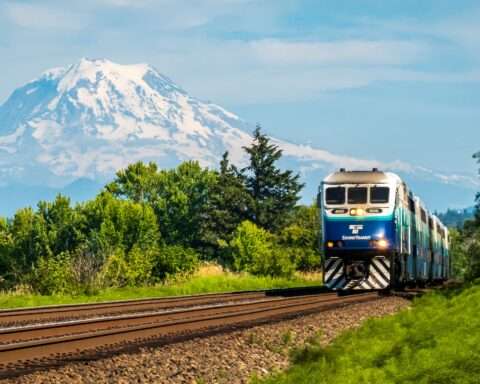
Image by Monika from Pixabay
For more of the latest from the expansive government marketplace, check Government Market News daily for new stories, insights and profiles from public sector professionals. Check out our national contracting newsletter here.