

Officials with the U.S. Department of Transportation (DOT) on May 18 released the 2026 National Freight Strategic Plan (NFSP), a five-year road map intended to guide federal policy and investment across the nation’s nearly seven-million-mile multimodal freight network.
The document from the DOT highlights six strategic goals, including safety, efficiency, security, resilience, innovation and workforce development. Those goals are meant to establish a shared framework that would inform how the DOT awards competitive grants and shapes federal regulations affecting freight.
According to DOT figures, more than 54 million tons of goods, worth over $68 billion, move along the freight network on a daily basis. These goods travel across a network of highways, railways, ports, inland waterways, pipelines and airports.
The six goals outlined in the plan cover high-level initiatives from the department. Under the safety goal, the plan calls for focusing federal resources on the highest-risk freight corridors. This includes accelerating deployment of safety technologies such as positive train control and automated braking systems, along with strengthening hazardous materials preparedness. The efficiency goal directs the department to address the most consequential freight bottlenecks spanning the interstate system, port access routes, inland waterway locks and rail junctions. It also pushes for streamlined federal permitting and clearer guidance for multimodal projects.
The security goal puts emphasis on the protection of freight assets that support military transport and mobility, along with reduction of cargo theft and fraud across the supply chain. Improved cybersecurity for freight operators is also mentioned in this area.
The plan’s resilience goal focuses on finding weak points in the national freight network and addressing them by adding rerouting options on critical corridors. The innovation goal looks to advance testing of newer freight technologies, such as automated trucking and vehicle-to-everything (V2X) communications, and promote a digital standard for freight data.
The workforce goal centers on recruiting and training of drivers and operators, with particular attention to upskilling for a more technology-driven freight system.
The plan also identifies specific areas of the national freight network that, according to the DOT, require the most attention. These include rail, highways and the inland waterway system.
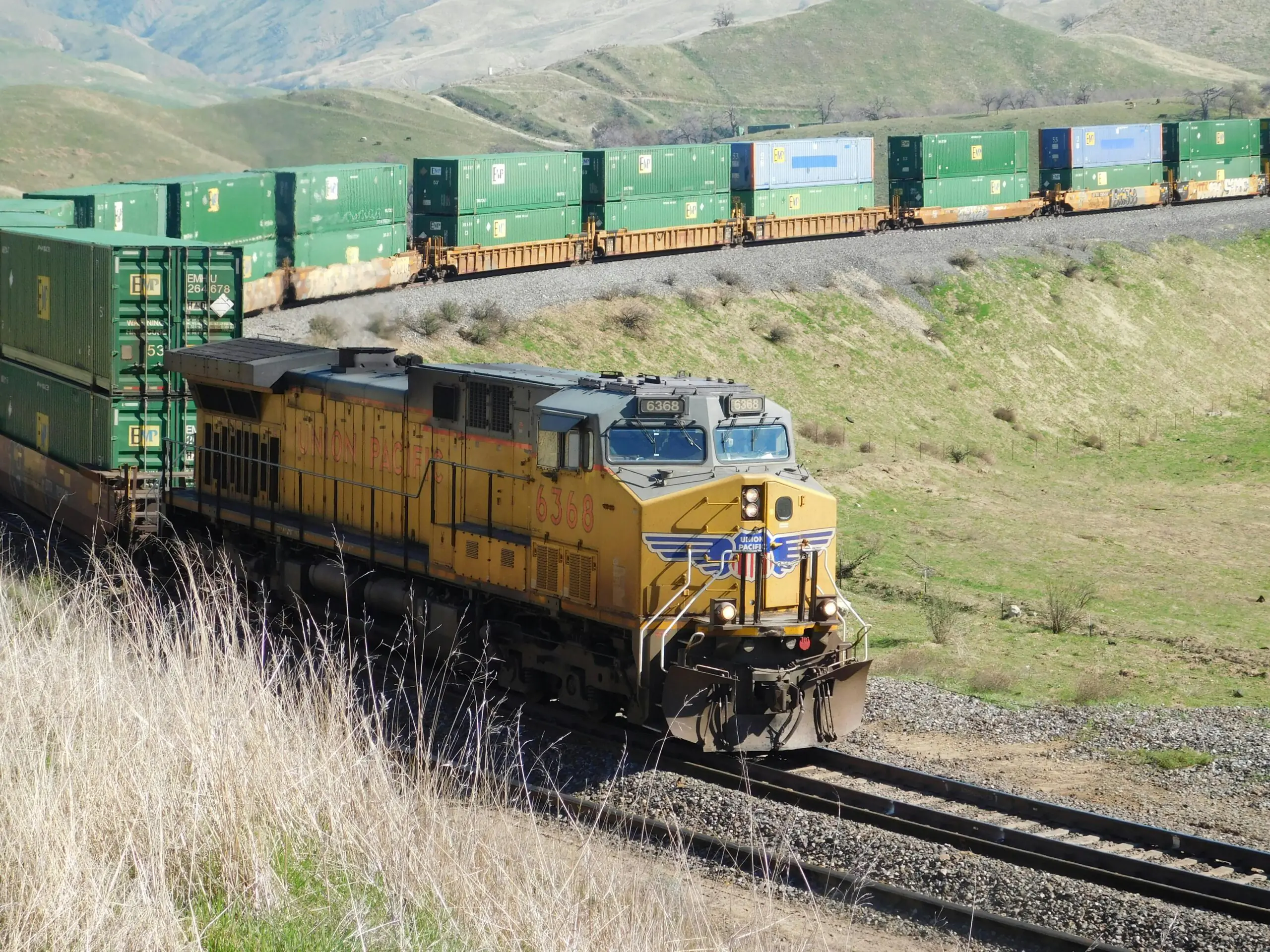
On the rail side, the plan covers a network of about 136,000 route miles operated by hundreds of railroads. The DOT projects rail freight tonnage will grow by an estimated 38% by 2050, with the dollar value of that freight rising by about 56% over the same period.
The plan flags several rail conditions limiting performance, including short line track that cannot safely carry today’s heavier freight cars, limited public data on privately owned rail bridges and grade crossing blockages caused by longer trains. To address these gaps, the document points to two Federal Railroad Administration (FRA) programs: the Consolidated Rail Infrastructure and Safety Improvements program, which funds track, capacity and safety upgrades, and the Railroad Crossing Elimination program, which funds grade separations.
For highways, the plan identifies more than 1,600 bridges on the freight network rated in poor condition. Among those, 53 interstate bridges would force detours of 50 miles or more if closed. It also calls attention to bridge and tunnel strikes by oversized trucks, which it estimates cause about 220 deaths a year, along with 108 bridges on the network that have vertical clearances below the 14-foot clearance that most trucks need.
On the trucking side, the plan highlights the 2025 Pro-Trucker Package, a department initiative that directs more than $275 million toward truck parking expansion and opens new competitive grants for parking projects.
The plan also identifies aging lock and dam infrastructure as one of the freight network’s most urgent reliability concerns. The locks allow barges to move between different water levels along the country’s rivers, but about 80% of those structures have now exceeded their designed service life. The U.S. Army Corps of Engineers reported four lock failures in 2024 alone.
The plan points to the Maritime Administration’s (MARAD) Port Infrastructure Development Program as a primary funding source for port-side improvements, along with its Marine Highway Program, which designates 35 all-water freight routes meant to take pressure off highway corridors.
The DOT frames its role in the plan as supporting state and private sector investment rather than directing it, with implementation to come through existing programs and authorities. For example, the plan reports that federal grants have directed about $4.1 billion to more than 200 freight rail projects since 2022, along with Class I railroads investing another $26.7 billion of their own capital in 2023. Federal competitive grants and state funds have also directed about $3.1 billion to 144 maritime projects since 2022, with about half of that funding supporting capacity expansion.
The NFSP from the DOT replaces the 2020 version, as it is required by law to be updated on a five-year cycle.
Photo by Bill Silveira from Pexels
For more of the latest from the expansive government marketplace, check Government Market News daily for new stories, insights and profiles from public sector professionals. Check out our national contracting newsletter here.