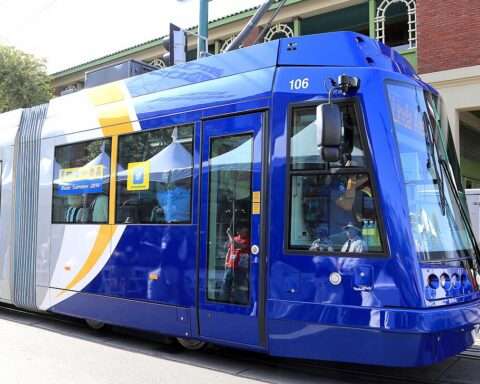



The Spokane Regional Transportation Council (SRTC) in Washington has revealed its plans to invest $16 billion in capital projects through the Horizon 2050 Spokane Metropolitan Transportation Plan. Planned investments will cover capital improvements, preservation of transportation systems, integration of new technologies and safety enhancements.
The SRTC Board approved the plan Dec. 11, 2025, accepting the transportation blueprint as city’s Metropolitan Transportation Plan (MTP) and Regional Transportation Plan (RTP). The plans are updated every four to five years, with the latest iteration containing:
- Planning for all modes of transportation, including vehicles, freight, transit, active transportation, air and rail.
- A summary of regional transportation needs alongside cost and revenue forecasts.
- An update of the region’s demographic and population projections.
- Information regarding cost-feasible regionally significant transportation projects.
Of the four investment categories featured in the plan – Preservation, Maintenance and Operations, Regionally Significant Projects and Transportation Programs – most of the spending will go toward projects in the Preservation and Maintenance and Operations categories. Out of the $16.1 billion in investments, the SRTC Board plans to dedicate $7.4 billion to Maintenance and Operations, $4.6 billion for Preservation, $2.1 billion for Programs and $2.1 billion for Regionally Significant Projects.
Of the $2.1 billion slotted for Regionally Significant Projects, the board plans to spend $939.4 million on short-term projects between 2026 and 2032. The remaining $1.1 billion will cover 18 projects between 2033 and 2050.
The largest short-term project featured in the plan will be the $632.5 million US 395/North Spokane Corridor project from Spokane River to Interstate 90. Led by the Washington State Department of Transportation (WSDOT), the project will complete the final phase of new freeway and interchanges at Trent Avenue and I-90. The initiative has a planned kickoff in 2026.
The Spokane Transit Authority (STA) is slated to receive $166 million to implement bus rapid transit (BRT) improvements on North Division in 2028. Another $53.4 million will be awarded to Spokane Valley for the Sullivan Road/BNSF Grade Separation project, with plans to reconstruct and widen the Sullivan Road bridge over the BNSF railroad. Additional short-term projects include:
- The STA will receive $39.3 million to revise a high-performance transit (HPT) corridor by adding two park and rides and modifying an existing park and ride in 2026.
- Spokane Valley will spend $28.2 million to replace a bridge along the Argonne Road/I-90 Interchange in 2027. The project will add a third southbound lane, wider shoulders and a sidewalk.
- Spokane Valley will receive another $12.5 million to widen Barker Road from a three-lane rural section to a five-lane urban section in 2028.
- Spokane County will use $7.5 million in 2026 to reconstruct Harvard Road to add shoulders, a pathway to the east side, a new signal and a roundabout.
The SRTC board implements projects using seven strategies to guide policymaking, development and both long- and short-term large-scale capital projects.
These strategies include:
- Prioritize preservation, maintenance and operations to sustain a state of good repair for the existing transportation network.
- Improve safety and security for the regional networks and systems through worthwhile investments and policies.
- Support transportation systems management and operation by maximizing the efficiency of the existing system through cost-effective approaches.
- Identify and support cost-effective transportation solutions through innovative, long-lasting construction techniques and appropriate planning and coordination.
- Invest in public transportation to support those living in urban areas, rural communities and tribal reservations and trust lands.
- Provide multimodal options to connect residents to community destinations and public places through walking, driving, bicycling and public transportation.
- Promote regional leadership to facilitate cross-jurisdictional transportation solutions.
Photo by JTRamsey, CC BY 4.0 https://creativecommons.org/licenses/by/4.0, from Wikimedia Commons
For more of the latest from the expansive government marketplace, check Government Market News daily for new stories, insights and profiles from public sector professionals. Check out our national contracting newsletter here.